Wildfire Preparation 2026
Many of you who attended our public wildfire-prep sessions in the spring of 2026 -- and many others who could not attend -- have asked that we post the slide deck to revisit and share the information that was presented.
After a record warm and record dry winter, wildfire concerns rightfully are foremost on the minds of Summit County residents. We shared the following images at five public presentations in April of 2026, intended both to shed light about our capabilities and what the community realistically can expect, and to offer the information that residents need to know to be adequately prepared.

Summit Fire & EMS, along with our counterparts at Breckenridge-based Red, White & Blue Fire, have prepared for this wildfire season similarly as we have in past years -- in part because we could have a threatening wildfire any year. Every firefighter maintains wildfire certifications, and on-the-ground and classroom training each year helps keep their skills honed.

Summit Fire & EMS keeps fully equipped wildfire engines and response vehicles at each of the five 24/7 fire stations to provide quick response to any report of a wildfire.
It's important to know that, between the two fire departments in Summit County, a couple dozen firefighters typically will get to a fire within the first hour or so of a fire being called in. Our goal is to contain and control any fire near our developed areas as quickly as possible, keeping it small before it overwhelms our resources.

But Summit Fire & EMS is not alone in fighting wildfires here. Because nearly 80 percent of the land in Summit County is controlled by the U.S. Forest Service, that organization keeps a wildfire engine stationed in Silverthorne and usually is part of the initial attack -- if it has not been dispatched previously to another area.
SF&EMS has numerous mutual-aid agreements with neighboring communities, the state and federal government, meaning that outside assistance can be summonsed. The department participates in the Mountain Area Mutual Aid pact, sharing wildfire response with other fire departments throughout the Central Mountains, and it works with the Colorado Division of Fire Prevention and Control on a larger-scale mutual aid, both sending out our firefighters to other parts of the state when requested and seeking assistance when a fire occurs here.
Also, SF&EMS participates in the federally organized Upper Colorado River Fire Management Unit, based out of Grand Junction, which enlists firefighters from throughout the region and can request assistance from firefighters across the nation. Any time a wildfire threatens to grow beyond our response capabilities, help will be requested.

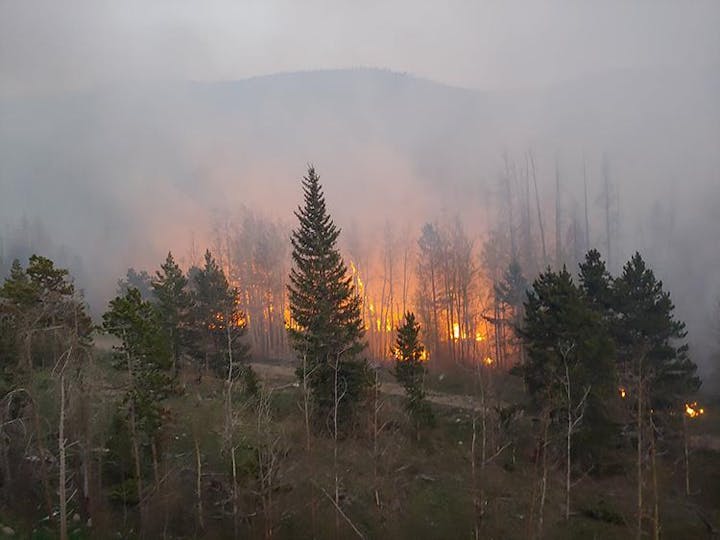
Wildfires reach homes in a couple of different ways. The most dramatic is when a fire front roars into developed areas ...

... but the most common way is when an ember shower from a nearby fire blows into neighborhoods, potentially igniting "spot" fires well ahead of the fire front. If the embers find a receptive fuel source close to a structure -- say a pile of dried leaves beneath a porch, or a bed of pine needles that have accumulated in gutters -- those small fires quickly can ignite the entire building.

To minimize the threat of embers starting fires that burn down buildings, we want to employ two important tactics: Home hardening and defensible space.

The notion of defensible space is that it is an area around a structure safe for firefighters to defend it from an approaching wildfire. Or, even better, it allows the structure to survive an ember storm and flame front even without the intervention of firefighters. We do this by reducing the volume and density of flammable vegetation the closer it is to structures, knocking the steam out of wildfires and bringing the flames to the ground with lower intensity.

We consider three significant zones around a home for defensible space. The immediate zone, within the first five feet of a structure, is the most important. Here, we want no combustible materials at all -- ideally gravel, flagstones and pavers without grasses or weeds. This minimizes the possibility of direct flame contact with structures.
The second zone, out to 30 feet, should have clumps of vegetation, including sporadically spaced trees, broken up by spaces between them with lower vegetation, so that there is not a continuous line of fuel leading a wildfire to a home.
And, if available, the third zone, out to 100 feet, still should have reduced vegetation and "ladder fuels" than the surrounding landscape, to slow the spread of wildfire.

Home hardening typically is designed with the construction of the home, using fire-resistant materials, but it also should be considered any time there is a renovation.
Among the ways to harden an existing home, aging wood siding can be replaced with non-combustible cement-board, stone or metal, and single-paned windows can be swapped out with tempered double- or triple-pane glass. Ideally, the bottom foot or more of a structure has stone or other non-flammable siding.
Additionally, buildings should have a Class A roof (required in Summit County for more than 30 years now) and 1/8-inch steel screens stapled to the inside of all external vents. These materials all will reduce the likelihood of embers igniting a home from the outside.
Wood or log siding, as long as it is properly maintained and kept without cracks or gaps, is not necessarily a huge liability, as embers will bounce off and burn out after falling to the ground -- as long as there is nothing on the ground to ignite.

Pop quiz time: What needs to be done to improve this home's fire resilience? Yes, definitely cut the grass -- it should be no higher than six inches within the first 30 feet of the structure. Do those trees overhang the structure? If so, some prudent limbing may be in order, or possibly taking down the tree entirely, especially if the canopy is continuous with heavy trees or vegetation farther away.

And here: Yes, the obvious answer is to clear the valley of the roof and the gutter of pine needles. The same mechanism that deposited those needles and leaves there -- the wind -- is what is going to carry swirling embers from a wildfire, and those embers will come to rest in the exact same spot. A bed of pine needles is perfect kindling for starting a fire. Clear out areas beneath decks and in the wind eddies of your home -- anywhere where flammable debris can nestle up against the structure. (In this case, even with a Class-A roof, metal gutters and well-maintained siding, a fire starting in these needles can be pushed beneath the eave to the exposed plywood soffits, catching the home on fire.)

This photo always elicits a lot of suggestions for improvement. Replacing the dilapidated shake-shingle roof would be an important start, as that is the home's largest exposure to embers. Far easier -- and also important -- is to move stacked firewood at least 30 feet from the home. In the winter, when plenty of snow is on the ground, we're comfortable with having firewood within easy reach, but once the landscape dries out, it needs to be removed. Trees overhanging roofs and decks are big red flags, both because they can carry fire to the structure and because branches can trap embers on the roof. The propane tank should be kept clear of combustible vegetation. And what about replacing aging wooden decks and exterior staircases with synthetic decking that is less likely to catch on fire?

In this video demonstration created by Cal Fire, fire brands were blown at the two structures to mimic a wildfire ember storm. The structure on the right has been "hardened" with fire-resistant siding, a gravel apron around the base of the building and a segment of metal fence immediately adjacent to the building. The one on the left has wood mulch and flammable vegetation right up against the wood siding, and a highly flammable cyprus tree and wooden fence right next to the structure. Guess what happens.
When a wildfire approaches a neighborhood, firefighters often will conduct a hasty size-up of the homes in its path to determine where to best expend limited resources. In an ideal situation, a property owner has created sufficient defensible space and hardened the home to the point that firefighters can move on to work on other properties, confident that the first home likely will survive a wildfire.
The designation "defensible -- prep and hold" means that, with a little work, firefighters can improve a home's likelihood of survival, and it is a safe place for them to remain to keep flames from reaching the structure.
"Non-defensible -- prep and leave" means it is not safe for firefighters to stay, but they can conduct some rapid mitigation work, such as moving wood piles, cutting down or limbing trees or wrapping the structure in foam or fire-resistant sheeting, if time and personnel allow.
And "non-defensible -- rescue drive by" means that they cannot expend the resources to save the home, and they solely are going to make sure everybody is out to safety. These determinations can be established well in advance, based on what defensible space the property owner does before a fire ever starts.

Many tactics to improve a home's likelihood of surviving a wildfire ember storm can be done fairly quickly and easily, and they will make a significant difference. Clear pine needles and leaves from wherever they've accumulated on and near the home. Move firewood at least 30 feet away. Mow grasses. Remember: Any one thing you do that can keep fire from reaching your home may be the one thing that saves your home.
If you have any questions, Summit Fire & EMS is glad to set up a one-on-one FREE, non-obligatory wildfire assessment, to help you prioritize any actions you may want to take to prepare your home and yourself for wildfire. Sign up here: https://www.summitfire.org/courtesy-home-wildfire-assessment

When a fire is reported near your community, it's important to take quick, decisive action to get you and everyone in your household to safety. Planning for the possibility of a wildfire now will mean a lot less frantic actions if you ever get that evacuation order. Don't wait to start the evacuation process -- you do not want to get caught in a traffic bottleneck or risk driving through smoke or flames, and you always can come back once the threat is over.

The primary way you will be notified of a wildfire is through the free text- and email-messaging service called Summit County Alert. Sign up for this vital communication channel at www.scalert.org.
We have other means of reaching people, too, intended to ensure that everyone receives an emergency message. Those include text messages sent to every mobile phone in an area and, if personnel and safety allow, literally going door to door to spread the word.
Know that each one of these emergency-notification systems has a failure point (for example, cell towers often get overwhelmed during emergencies, delaying messages, or they can burn down), so the important thing is to listen to your gut. If you and your neighbors are watching a nearby hillside burning and wondering if you should stay or go, the answer is that you already should have gone.
Do not wait for authorities to tell you to evacuate; that message may not ever arrive.


Before a fire ever starts, it's important to back up all valuable documents and photos digitally, and to save those files off site (either on the internet cloud, or on storage drives kept in a different location). When people have lost homes in wildfires around the country, they don't cry about the loss of the television; they lament the loss of the irreplaceable family photos. There are companies that will back up your entire photo album, or you can acquire a scanner and store the images as digital files yourself.

A shocking statistic that comes out of wildfire after wildfire in the United States is that a majority of homeowners find out too late that they are under-insured. This can make the difference between being able to rebuild ... or not. Have an annual conversation with your property-insurance agent to discuss your coverage, based on current construction and replacement costs. Renters also should obtain property insurance, which can be very affordable.

Differing from your 72-hour evacuation kit kept in your vehicle, this list helps you prioritize what possessions you would grab and put into your vehicle if you have the luxury of a little bit of time. Build this list now. Start by determining your absolute most valued/irreplaceable possessions that you would grab if you had only 30 minutes. Add a second section of items to retrieve if you have up to an hour, and a third section of items to add if you have as long a two hours. Quickly gather the items on your list, making sure to save space for people and pets in your vehicle.

It's important to have a plan for getting yourself and everyone in your household out, in case your neighborhood is evacuated because of a wildfire. Do you have arrangements with family friends or relatives to pick up your children at daycare or school, and are those adults on the facility's approved pickup list? If you are not at home when a wildfire has prompted evacuations, have you entrusted a neighbor or two with keys to your place and directions to get your pets out? Make these plans now, and determine a way to get reunited: meeting at friend or relative's home in another community, heading to the evacuation center or having everyone carry a phone number of a person outside the community that you all know how to reach.

The vast majority of wildfires are caused by humans, meaning that many can be prevented with a little bit of caution and conscientiousness. Be aware of your surroundings and be cognizant of any sources of flame, spark or heat.
Also, be good stewards and conscientious members of the community. Call 9-1-1 for smoke sightings in the woods. Share your knowledge with others. Watch out for potentially dangerous activities. Communicate and coordinate with neighbors about fire prevention or emergency preparation. Look out for each other.

In Summit County, all campfires on private property must be approved under a FREE permit issued by the local fire department. Fire pits must be in a safe location, adequate ember screens need to be placed over them while they are burning, and a method of extinguishing the fire must be on hand at all times. Campfires should never be left unattended. If you see unsafe acts with backyard campfires, call local law enforcement.
Other points of caution include avoiding parking vehicles in tall grass and make sure that spark-producing tools including chainsaws have working spark arresters.
Finally, any firework that flies or explodes is prohibited in Summit County and all fireworks are prohibited anywhere in the White River National Forest. Please be respectful of the entire community and promote safety by abiding by these regulations.

For more information, tips and wildfire-prep organizers, see https://www.summitfire.org/wildfire-information.
For questions, please call Summit Fire & EMS at (970) 262-5100.